Where Do You Find Carvaggio’s Greatest Masterpieces in Situ?
Seeing Caravaggio in Situ: Rome’s Original Masterpieces
Introduction: In Situ
“In situ,” a Latin phrase meaning “in its original place,” refers to artworks displayed exactly where they were created or commissioned. Seeing Caravaggio’s paintings in situ—within the chapels or villas for which they were intended—enhances both their spiritual impact and historical authenticity, as light, architecture, and ritual combine to reveal the art’s full effect.
For art lovers, there’s nothing quite like encountering Caravaggio art where it was originally intended. In Rome, four works by Michelangelo Merisi—now universally known as Caravaggio—remain fixed within their commissioned sites. They stand as powerful relics of Counter‑Reformation drama, theological storytelling, and revolutionary naturalism. Here’s your in‑depth guide to these authentic experiences:
1. Contarelli Chapel, San Luigi dei Francesi
Works: The Calling of Saint Matthew; The Martyrdom of Saint Matthew (1599–1600); The Inspiration of Saint Matthew (1602)
This trio marks Caravaggio’s first significant public commission, funded by Cardinal Matteo Contarelli’s estate. The cardinal, who died in 1585, left explicit instructions to depict his namesake, St. Matthew, in scenes from his life. Originally assigned to Mannerist artists and sculptors, the project stalled—until Caravaggio, championed by Cardinal Del Monte, took over in 1599. Here, Caravaggio introduced a radical realism: everyday figures, dirt‑smudged and relatable, set in moments charged with spiritual urgency. The chapel’s original architecture and lighting become integral to the narrative experience.
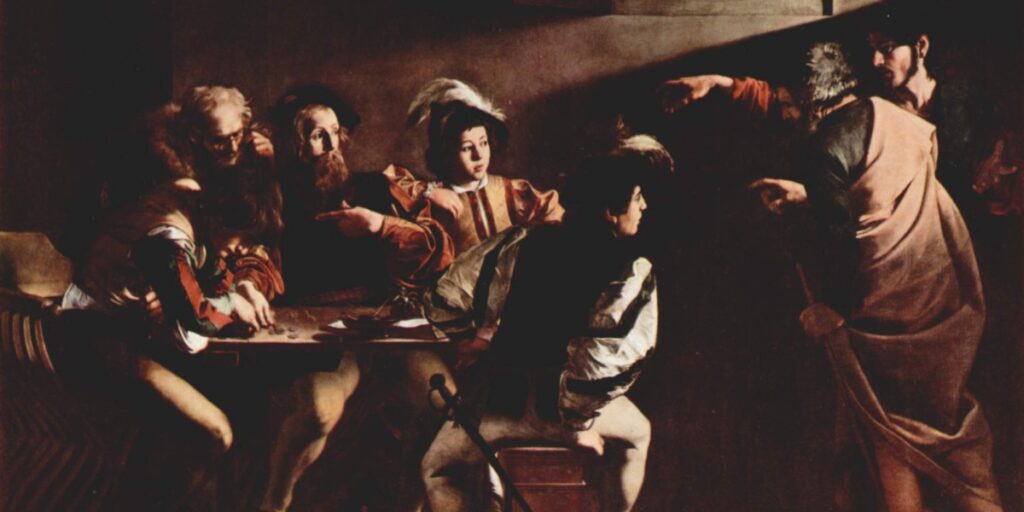
- The Calling arrests you with a single beam of light cutting through the chapel’s gloom, illuminating Matthew mid‑conversation as Christ beckons him—a powerful motif borrowed from Michelangelo’s Creation of Adam.
- The Martyrdom, a visceral depiction of Matthew’s death during Mass, bubbles with human panic and divine stillness: the executioner’s poised blade, the angel’s silent intervention, the chaotic crowd—a chiaroscuro crescendo.
- The Inspiration, the altarpiece painted to replace a rejected earlier version, shows an eagle‑messenger angel dictating the Gospel to a stooped, illuminated Matthew—a study in humility and divine grace.
2. Cerasi Chapel, Santa Maria del Popolo
Works: The Conversion of Saint Paul; The Crucifixion of Saint Peter (1600–1601)
Commissioned by Tiberio Cerasi—treasurer to Pope Clement VIII—this intimate chapel was a papal mise‑en‑scène, combining theological boldness with Baroque elegance. These works are psychologically charged and structurally bold, using compact space and high drama to underscore themes of repentance, obedience, and spiritual rebirth.
- Conversion of Paul portrays Saul mid‑fall, illuminated by a radiant, unseen light; his humbled body and fallen horse evoke spiritual surrender and divine intervention.
- Crucifixion of Peter offers no messianic idealism: Peter’s agony during upside‑down crucifixion unfolds in dramatic foreshortening, confronting viewers with visceral humanity and devotion.
3. Cavalletti Chapel, Sant’Agostino
Work: Madonna of Loreto (Pilgrim Madonna) (c. 1604–1606)
Commissioned by the Cavalletti family, this modest chapel houses one of Caravaggio’s gentlest yet most groundbreaking devotional images. This intimate altarpiece envisages the divine among the poor—a theological democratization rendered in quiet stone and soft daylight.
- The Virgin, barefoot and halo‑less, stands in a crumbling doorway; two dusty pilgrims kneel before her. Caravaggio’s radical naturalism emphasized humility and everyday piety over traditional idealization.
4. Casino Aurora, Villa Boncompagni Ludovisi
Work: Jupiter, Neptune and Pluto (c. 1597)
Caravaggio’s only surviving mural sits in the alchemy‑room ceiling of Cardinal Del Monte’s villa, rediscovered in 1969. This private commission combines classical mythology with esoteric symbolism and his signature dramatic perspective. This rare secular Caravaggio masterpiece shows the artist’s versatility beyond religious narratives, quietly revolutionizing spatial illusion and alchemical symbolism within a closed, ritual space.
- The trio of gods personifies Paracelsus’s three alchemical principles—sulphur, mercury, salt—surrounding a celestial sphere. Foreshortening places viewers beneath the gods’ limbs, creating an immersive, almost theatrical experience.
What Makes These In Situ Works So Special
- Architectural Context: Caravaggio painted with built spaces and natural light in mind—seeing these works in their actual locations reveals his mastery of spatial drama.
- Symbolic Commissioning: Each piece was tailored to exactly the patron’s theme: Counter‑Reformation calls, papal loyalty, intimate devotion, or cosmological inquiry.
- Theatrical Composition: The composition, lighting, and narrative interplay with the chapel settings, creating devotional and dramatic experiences impossible to replicate in a museum.
As you reflect on visiting Caravaggio’s four truly in situ masterpieces, each still harmoniously integrated within its original architectural setting, it’s also worth noting Rome’s wider holdings of his work, now famously preserved in museums. While not in their initial chapels, these relocated treasures continue to draw art lovers and scholars alike: at the Galleria Borghese, masterpiece highlights include David with the Head of Goliath, Boy with a Basket of Fruit, Saint Jerome Writing, and Madonna and Child with Saint Anne; the Vatican Pinacoteca proudly displays The Entombment of Christ ; and both the Galleria Doria Pamphilj and Capitoline Museums hold exquisite works like Penitent Magdalene, Rest on the Flight into Egypt, Saint John the Baptist, The Fortune Teller, and Saint John with a Ram. Though no longer in their original settings, these paintings maintain Caravaggio’s potent realism and emotional depth, offering visitors complementary perspectives on his genius—both in sacred spaces and museum halls.
Final Invitation
Ready for a pilgrimage into the original Caravaggio’s masterpieces? The Art History Tour of the Italian Baroque: Caravaggio and Bernini, by The Thoughtful Traveler, is a refined, immersive journey through Rome’s authentic sites—chapels, villas, and hidden corners—then onward to Sicily and Malta. Discover these masterpieces in their intended settings, and experience first‑hand the artistry that reshaped European painting. It’s more than sightseeing—it’s art‑historical immersion at its finest.