Top Ten Baroque Highlights of Rome
The Best of Baroque in Rome
Rome, the very heart of Baroque architecture in Italy, is an extraordinary classroom for art history enthusiasts. From majestic basilicas to tucked-away chapels, the city’s famous Baroque buildings showcase a period when artists channeled drama, motion, and light into stone, stucco, and paint. This curated journey allows you to trace the emotional pulse of the era from grand monuments to those hidden masterpieces that reward the curious few.
1. Il Gesù
The Church of the Gesù is the mother church of the Jesuit order and widely recognized as the first truly Baroque façade. Its Latin‑cross plan, side chapels, and soaring dome—enhanced by Giovanni Battista Gaulli’s ceiling fresco, The Triumph of the Name of Jesus—set the template for Baroque architecture across Italy and beyond. It remains essential for understanding the movement’s origins.
2. Santa Susanna
Designed by Carlo Maderno around 1603, the façade of Santa Susanna is another early statement in Baroque architecture in Italy, built upon the innovations first seen at Il Gesù. Its restrained yet refined detailing marks the transition from Mannerism to full Baroque exuberance.
3. Sant’Ivo alla Sapienza
Francesco Borromini’s architectural jewel, Sant’Ivo alla Sapienza, stands in the courtyard of Rome’s historic university. The corkscrew lantern crowning its dome and the interplay of concave and convex geometries create an optical and spiritual ascent in a compact space—an exemplar of inventive Baroque ambition.
4. San Carlo alle Quattro Fontane
Also by Borromini, this petite church—“San Carlino”—proves that a small plot need not limit grandeur. Its dynamic façade undulates like a ribbon of stone, reflecting the broader movement of Baroque away from static Renaissance symmetry to animated, spatial drama.
5. Sant’Andrea al Quirinale
A masterful work by Gian Lorenzo Bernini, Sant’Andrea al Quirinale offers an intimate, theatrical experience. With its oval plan, gilded dome, and enveloping nave, it epitomizes the peak of Baroque architecture—a seamless marriage of sacred space and emotional storytelling.
6. St. Peter’s Basilica & Square
Though initiated in the Renaissance, St. Peter’s received its fully Baroque identity through Carlo Maderno’s façade and Bernini’s breathtaking colonnade—embracing visitors with four rows of Doric columns. This dynamic design reshaped how architecture could physically engage with the faithful and became a template emulated throughout Europe.
7. Palazzo Barberini
As one of Rome’s great palaces, Palazzo Barberini (1625–33) represents Baroque’s evolution in domestic architecture. Designed by Carlo Maderno, Bernini, and Borromini, its grand H‑shaped layout, magnificent staircase, and frescoed salons embody secular splendor. Its Galleria Nazionale d’Arte Antica houses monumental frescoes like Pietro da Cortona’s The Triumph of Divine Providence, emblematic of the era’s decorative synergy.
8. Santa Maria della Vittoria and “The Ecstasy of Saint Teresa”
Tucked behind a modest façade, this church houses Bernini’s most intensely theatrical sculpture. The Ecstasy of Saint Teresa transforms marble into pulsing flesh and fabric, alight in a hidden chapel designed like a stage set—where architecture, sculpture, and divine vision merge.
9. Fountain of the Four Rivers & Trevi Fountain
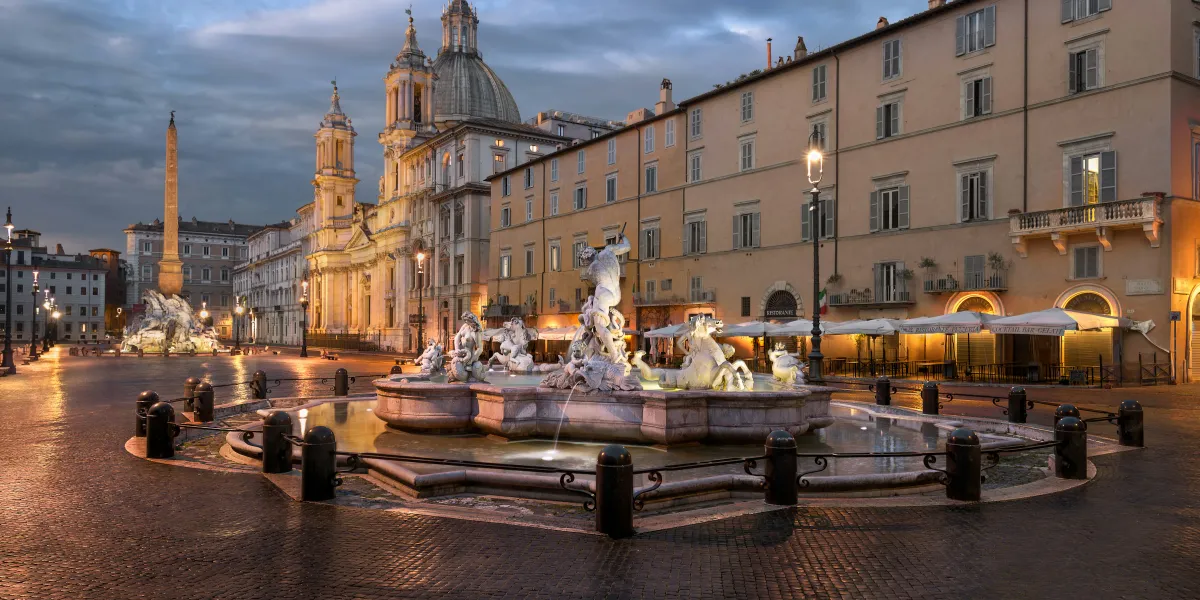
At Piazza Navona, Bernini’s Fountain of the Four Rivers transforms myth into living motion. Nearby, the Trevi Fountain stands as one of Rome’s most famous Baroque buildings, its Rococo‐tinged drama still summoning crowds to toss coins for luck.
10. Caravaggio Art in Roman Churches
No Baroque survey is complete without chance encounters with Caravaggio art. His transformative realism and chiaroscuro are found in situ across the city—The Calling of St. Matthew, The Martyrdom of St. Matthew (San Luigi dei Francesi), Conversion of St. Paul and Crucifixion of St. Peter (Santa Maria del Popolo), and Madonna di Loreto (Sant’Agostino). These visceral masterpieces capture divine drama in everyday settings and anchor the painter’s influence on the broader Baroque movement.
Why These Matter
Rome’s Baroque journey—from Il Gesù’s doctrinal compositions, through Borromini’s architectural daring, Bernini’s sculptural theater, to Caravaggio’s psychological realism—charts a profound interplay of Baroque architecture in Italy and painting. Each location presents a facet of the period’s power: the emotional outreach of the Church, the grandiosity of the papacy, and the lyrical, human-centered spirituality realized by painters and sculptors alike.
A Cultural Journey Beyond Rome
Exploring Rome’s Baroque highlights is an ideal introduction to a broader tour that embraces Italy, Sicily, and Malta—showcasing monumental and intimate works that defined Europe’s artistic transformation.
Whether you’re drawn to famous Baroque buildings, innovative spatial designs, or the raw intensity of Caravaggio art, at The Thoughtful Traveler we offer a journey that fully immerses you in art‑history‑rich travel. Consider booking this exceptional tour to experience these masterpieces firsthand across Rome, Sicily, and Malta, and delve into why these sites remain Europe’s most compelling cultural treasures.