King Herod’s Greatest Hits: Herod’s Grand Construction Projects
When it comes to ambitious rulers who left a lasting mark on ancient Israel, few figures in history compare to King Herod the Great.
Ruling what was known then as Judea from 37 to 4 BCE under Roman authority, Herod was well known for both his ruthless political maneuvering and for his visionary architectural projects. His reign reshaped the landscape of Herodian Israel with cities, fortresses, palaces, and religious monuments that reflected both his loyalty to Rome and his desire to cement his own legacy.
Below are some of Herod’s greatest construction “hits”—projects that still captivate and capture the imagination more than 2,000 years later.
Caesarea Maritima: A Roman Port on the Mediterranean
Herod’s most ambitious urban project was Caesarea Maritima, built along the Mediterranean coast in honor of his patron, Emperor Augustus. What made Caesarea remarkable was its harbor—one of the largest artificial ports of the ancient world. Using a special type of Roman hydraulic concrete, Herod’s engineers created massive breakwaters that allowed ships to dock safely, linking Judea directly into Rome’s Mediterranean trade network.
The city itself boasted all the hallmarks of Roman urban design: an amphitheater, a hippodrome, temples, aqueducts, and a luxurious palace complex by King Herod, which jutted out into the sea. Caesarea became a symbol of Herod’s ability to fuse local ambition with Roman engineering, projecting both prosperity and loyalty to the empire. Today, Caesarea is also one of the most important Roman sites in Israel, drawing visitors from around the world.
King Herod’s Temple: Expanding Jerusalem’s Holy Mount
Herod’s expansion of the Second Temple in Jerusalem was both his most controversial and his most enduring achievement. To strengthen his legitimacy among his Jewish subjects, he undertook a complete rebuilding of the Temple, transforming it into one of the largest sacred platforms in the ancient world.
The Temple Mount was vastly expanded with towering retaining walls, sections of which remain today as the Western Wall. While the Temple itself was destroyed by the Romans in 70 CE, Herod’s platform and monumental stairways endure, offering a glimpse of the scale and ambition of his project.
The Temple stood not only as a religious centerpiece for Judea but also as a political statement: Herod was a ruler capable of rivaling Rome’s grandeur while addressing local traditions. This monumental undertaking remains one of the most iconic examples of ancient Israel architecture.
Masada: A Fortress Above the Dead Sea
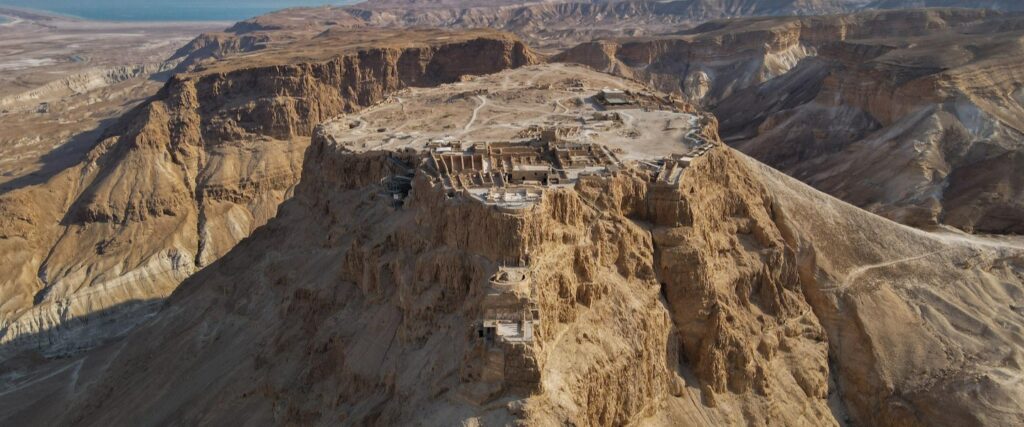
High above the Dead Sea, the fortress of Masada exemplifies Herod’s blend of luxury and security. Built on a desert plateau, Masada included a lavish palace complex, storerooms, Roman-style bathhouses, and a sophisticated water system that collected and stored scarce desert rainfall.
Though originally constructed as a secure refuge for Herod himself, Masada is better remembered for the events that occurred decades after his death. During the First Jewish Revolt (66–73 CE), Jewish rebels fortified the site against Rome. The dramatic siege and its tragic conclusion gave Masada an enduring place in Jewish history.
Herodium: The Palace on a Man-Made Mountain
Located near Bethlehem, Herodium was one of Herod’s most personal projects. Unlike his other fortresses, this site was designed not just for defense but as a lavish retreat and, ultimately, his final resting place. Herod ordered the creation of a man-made mountain, complete with a circular fortress-palace at the top and a sprawling lower complex with gardens, pools, and administrative buildings.
Herodium stood out as both a royal residence and a monument to Herod himself. Archaeological excavations suggest that King Herod’s tomb was located here, fulfilling his wish to be remembered at his most ambitious construction.
Other Projects Across Judea
Herod’s building spree didn’t stop with the headline monuments. He rebuilt the city of Samaria, renaming it Sebaste in honor of Augustus. He constructed fortresses such as Alexandrium and Machaerus, both serving as strategic strongholds and symbols of his authority. Cities, aqueducts, theaters, and palaces across Judea bore his mark, ensuring that few corners of the region escaped his influence.
Herod’s Legacy as Builder-King
Herod the Great remains a polarizing figure in history. Ancient sources describe him as paranoid, brutal, and politically ruthless, yet his architectural achievements speak to a vision and organizational ability that massively transformed Judea. His projects tied the region more closely to the Roman world while leaving behind landmarks that are still visited and studied today.
Whether gazing across the ruins of Caesarea, standing at the foot of the Western Wall, or hiking up to Masada, travelers encounter the scale of Herod’s ambition firsthand, and his feats in ancient Israel architecture are still regarded as some of the most impressive legacies of the Roman period in the region. His buildings were not only feats of engineering but also expressions of identity, politics, and power in a land at the crossroads of empires.
Experience Herod’s World for Yourself
Herod’s construction projects can still be experienced today, offering travelers a tangible link to both the Roman Empire and the roots of Christianity. To explore some of these sites in depth, consider our Holy Land in the Time of the Caesars tour. This carefully designed trip includes visits to Caesarea, Masada, Jerusalem’s Old City, Beit She’an, and the Sea of Galilee, combining expert insight with a seamless, luxury travel experience.
Step into the landscapes of Herodian Israel and discover how Herod’s vision reshaped the land, with monuments that continue to captivate visitors today.