The Top Five Sights of Minoan Civilization
The Minoan civilization, Europe’s earliest advanced society, flourished on Crete and nearby islands during the Bronze Age (circa 2600–1100 BCE). Renowned for its sophisticated architecture, vibrant frescoes, and complex social structures, the Minoans left an indelible mark on history. For the intellectually curious traveler, the following five sites offer a window into this enigmatic culture.
1. Palace of Knossos – The Heart of Minoan Civilization
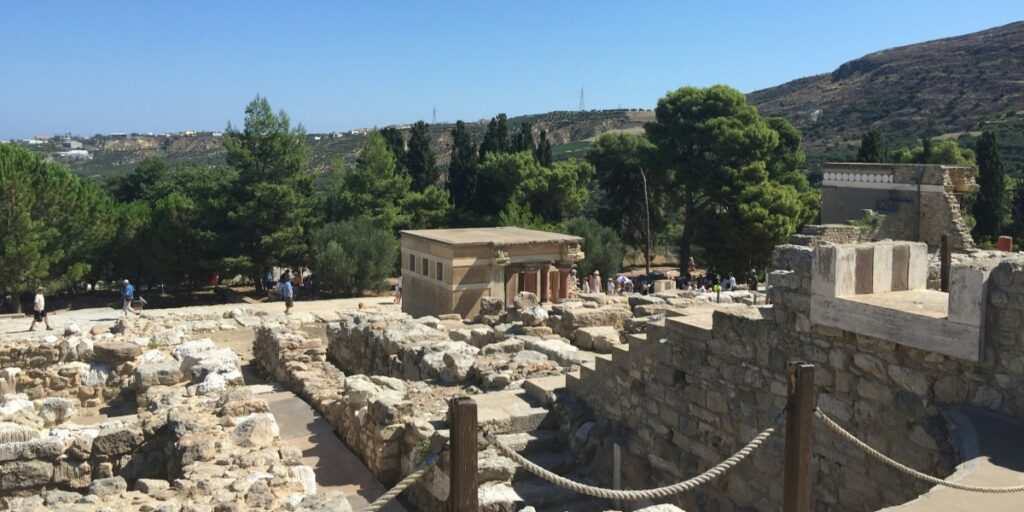
Located approximately five kilometers south of Heraklion, the Palace of Knossos stands as the most significant center of Minoan civilization. Covering an area of about 20,000 square meters, it showcases advanced architectural features such as multi-story buildings, elaborate drainage systems, and vibrant frescoes. Excavated extensively in the early 20th century by Sir Arthur Evans, Knossos provides invaluable insights into Minoan society and its complexities.
2. Akrotiri – The Minoan Pompeii of Santorini
On the southern coast of Santorini lies Akrotiri, a remarkably preserved Minoan settlement buried under volcanic ash following a catastrophic eruption in the 16th century BCE. The ash acted as a preservative, safeguarding multi-story buildings, intricate frescoes, and everyday artifacts. Excavations, which began in earnest in 1967, have revealed a sophisticated urban center, complete with advanced infrastructure and art, offering a unique glimpse into Minoan life.
3. Phaistos – A Testament to Minoan Architectural Prowess
Situated on the eastern end of Kastri Hill in central southern Crete, the Palace of Phaistos exemplifies Minoan architectural ingenuity. Overlooking the fertile Mesara Plain, this site was a major administrative and economic hub. The palace complex, characterized by its grand courtyards and intricate layout, reflects the Minoans’ advanced building techniques and their emphasis on communal spaces.
4. Gortyn – From Minoan Roots to Roman Rule
Located in the valley of Messara, Gortyn boasts a rich tapestry of history, transitioning from a Minoan settlement to the Roman capital of Crete and Cyrenaica. Among its most notable features is the Gortyn Code, the oldest and most complete known example of a code of ancient Greek law, inscribed on large stone slabs. The site also houses remnants of Roman architecture, including a theater, baths, and temples, illustrating the city’s long-standing significance.
5. Chania – Echoes of Minoan Kydonia
Modern-day Chania, on Crete’s northwest coast, overlays the ancient Minoan city of Kydonia. Archaeological findings indicate that Kydonia was a prominent Minoan center, with continuous habitation since the Neolithic period. Today, Chania’s Old Town, with its Venetian harbor and labyrinthine alleys, offers a blend of historical influences, reflecting its Minoan, Byzantine, Venetian, and Ottoman past.
For those eager to delve deeper into the wonders of the Minoan civilization, consider our curated trip to Crete, Santorini and Athens. Embark on an exploration of key archaeological sites, including the renowned palaces of Knossos and Phaistos, the well-preserved settlement of Akrotiri, and the ancient city of Gortyn. You’ll gain profound insights into Europe’s first advanced civilization. Complementing the historical exploration, the tour also allows you to experience the breathtaking landscapes of the Aegean, savor authentic Greek cuisine, and enjoy the vibrant culture of the region. This comprehensive experience is tailored for intellectually curious travelers seeking a deeper understanding of the Bronze Age heritage that shaped the Mediterranean world.