Crete’s Minoan Palaces
Before Athens or Rome, there was Crete
Widely recognized as Europe’s first advanced culture, the Minoan civilization flourished on this island. Known for their elegant architecture and vibrant art, the impressive legacy the Minoans left behind remains visible to this day. The ancient Minoan palaces of Knossos, Phaistos, Malia, and Zakros give thoughtful travelers the chance to explore the grandeur and complexity of one of Europe’s earliest sophisticated societies.
Knossos
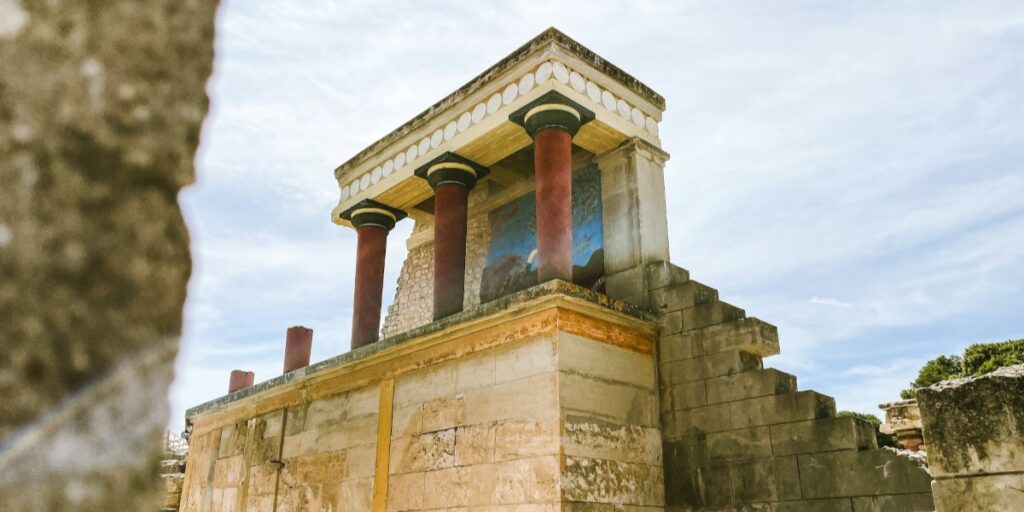
Just outside of Crete’s largest city, Heraklion, lies the Knossos palace, the largest and most famous of the Minoan palaces. Excavated in the early 1900s by British archaeologist Sir Arthur Evans, the Palace of Knossos was partially reconstructed to give visitors a sense of its original scale and color. Though some of his restorative choices sparked furious scholarly debate, Evans’ efforts brought the Knossos palace into the public eye, and it remains one of Crete’s most visited ancient sites today.
The Minoan Palace of Knossos spans multiple levels of decorated corridors, store rooms, and ceremonial chambers that all weave together into a sprawling and somewhat confounding layout. The complexity of the structure is so maze-like that it is widely considered to have inspired the mythological labyrinth Daedalus constructed to imprison King Minos’ son, the Minotaur. While not a literal maze, you’ll find it easy to see why the Minoan Palace of Knossos gave rise to these ancient stories.
Europe’s oldest known Throne Room is a must-see when visiting Knossos. Rich in elegance and a sense of power, the chamber has vibrant red walls adorned with frescoes of mythical griffins, and its centerpiece, a throne carved from pale stone, commands a silent and sacred authority.
Phaistos
Set above the Messara Plain in southern Crete, the Minoan Palace of Phaistos is the second-largest on the island. Italian archaeologist Federico Halbherr discovered the site in 1900, and it has remained largely unrestored since its excavation, offering visitors an unfiltered and atmospheric look into history.
The Palace of Phaistos was a major political and administrative hub for the region, and the foundations seen today date back to roughly 3,700 years ago. Wide courtyards, storerooms, staircases, and ceremonial spaces are all laid out with a remarkable sense of order and intention, and reflect the same careful attention to symmetry and flow that defined Minoan architecture.
One of the most intriguing discoveries at the site is the Phaistos Disk, a clay artifact unearthed in 1908. Stamped with a spiral of mysterious symbols, its markings remain undeciphered, and are believed to represent a form of the Minoan language with no known linguistic relatives. To this day, the Phaistos Disk continues to mystify archaeologists and linguists alike. You can see it today at the Heraklion Archaeological Museum, where it remains one of the most iconic and puzzling artifacts from the Minoan world.
Visitors standing at the edge of this palace will be treated to sweeping views across the Messara Plain—a reminder that Minoan architecture also valued the importance of beauty and setting in its designs. While it receives fewer visitors than Knossos, the Palace of Phaistos rewards those who venture to it with a quieter, more authentic glimpse into the ancient Minoan world.
Malia
Located on Crete’s northern coast, the Minoan Palace of Malia was built around 1900 BCE and served as a political, religious, and economic center for the Minoan civilization.
Like Phaistos, the Palace of Malia remains largely in its original state, giving visitors an authentic experience of the site. It consists of a central courtyard, storerooms, workshops, and residential quarters. It also has distinctive circular grain silos that once stored large quantities of barley and wheat for feeding the palace population, provisioning workers, and maintaining control over the local food resources.
The Palace of Malia is also famous for the discovery site of the iconic Gold Bee Pendant. Unearthed in 1930, this exquisite gold artifact is now housed at the Heraklion Archaeological Museum and is a symbol of the artistry, craftsmanship, and economy present in the Minoan civilization.
Zakros
The Palace of Zakros is the smallest and least-known of the Minoan palaces, yet perhaps the most historically significant. Located on Crete’s remote eastern coast, its strategic location near the sea made it a vital trading hub, connecting Crete with the Near East and hinting at the Minoans’ maritime capabilities and far-reaching connections.
The Palace of Zakros features a multi-story layout and has been the discovery site of many fascinating artifacts. Ancient pottery, jewelry, and intricate seal stones have all been uncovered on the grounds of Zakros, hinting at its wealth and importance in the Minoan world.
Destroyed around 1540 BCE during the civilization’s decline, The Palace of Zakros invites travelers to explore well-preserved ancient ruins in a quiet, atmospheric environment. Framed by dramatic cliffs and the sea, Zakros is the perfect place to capture the spirit of Crete’s ancient coastal trade.
Why the Minoan Palaces Still Captivate Today
From the maze-like corridors of the Palace of Knossos to the quiet shores of Zakros, Crete’s Minoan palaces offer travelers a captivating journey into a fascinating culture. Each site reveals a unique facet of Minoan life, inviting thoughtful travelers to step back in time and experience the complexity, artistry, and legacy of Europe’s first advanced civilization.